Tampilkan postingan dengan label Banks. Tampilkan semua postingan

Selasa, 16 Februari 2016

Breaking dollar's fungibility

In the modern world we rarely make a distinction between the money in our banks, the currency in our pocket, or our balance in a digital wallet like PayPal - a dollar is a dollar, pretty much fungible. However, that's not really the case - money deposited in a bank means the bank owes that money to you (it's not "your cash"), digital wallets also own your money and can easily freeze your balance. Transferring money from one bank to another is always done at par, even if that bank in question might be Lehman Brothers about to go down back in 2008. Perhaps it is time we break the dollar's fungibility and start putting a price tag on the credibility of banks?

Private notes


Over 150 years ago in the "free banking era", any bank could issue its own banknotes. You would see a number of different notes in circulation - you could have $2 from The Bank of Chattanooga, The County of Polk, or The Lawrenceburg Bank of Tennesee. Same in Canada. While it created a lot of hassle for anyone wanting to use the currency, especially if they would travel beyond where those notes would be redeemable, it also allowed for a market to form and put a real value on the currency based on how credible the issuing bank was - good notes would be valued at par, bad ones - at a discount.

While banking nowadays is certainly simpler and safer with uniform currency issued by one entity per country, FDIC deposit insurance to prevent people losing money in case a bank goes bust, etc. However, this means we also lost the ability to evaluate bank's trustworthiness, usability, etc. and arbitrage it.

Bank arbitrage


In the Bitcoin world, it is fairly straightforward to judge the health of an exchange by looking at its exchange rate. Back when MtGox was going bust, its rates deviated from its competitors by 15+% even early on. When withdrawals out of the exchange became impossible, there was even a secondary market that traded MtGox BTC for real BTC by using MtGox's inter-account transfer capabilities. You can track arbitrage metrics today.

How would this apply to banks? Well, you could start with the currency issued by the government as the base - one dollar here would be redeemable to one dollar in banknotes (this is what MintChip aimed to do for example). Banks would use that as their reserves for fractional-reserve banking and issue their own debt-based currency. All of it could be tracked on a shared "bankchain" to allow market for various bank debt to form. The price difference of the debt could stem from various factors - how stable the bank is (FDIC insurance is all well and good, but nobody wants to go through the stress of having your saving locked up for who knows how long), how cheap and easy it is to transact to and from a bank (say, USD-demoniated bank account in Europe might be valued less due to the extra cost of transferring money overseas), how accessible is the bank (branch opening hours and how common they are), as well as how their customers share the banks values (banking for millennials, sharia-compliant finance, etc.).

Setting up such simple metric for each bank would allow anyone to easily compare various banks and put that metric on everyone's mind. If one day your money would go down to 95 cents on the dollar, perhaps you would ask your bank "what is going on?" and find out that HSBC enabled Mexican drug cartels to launder money. Maybe it would enable some people to demand all of their deposits to be covered 100% by the government-issued currency, rather than allow for fractional reserve banking? Or perhaps it would allow some people to move their money to their local credit union to support the grassroot company and earn 1-2% on the conversion rate.

Conclusions


Banking in the modern world is pretty homogeneous - currency dictated by the government, fungible money no matter where you go. Perhaps it might be useful to bring the market back into the equation and allow us to see see the bank's worth by checking the value of their dollars?


Related links:


Selasa, 17 November 2015

Sample bankchain feature set

In the recent months, many banks and other financial institutions started looking into the blockchain technology as a potential improvement on their current architecture. Below is a sample feature set of the cryptocurrency technologies that can be used to reimplement and possibly improve upon the banking system as it is today.

Transactions


In all cryptocurrency systems, transactions are the most basic building block of the value transfer network. They have a few important features, including:

  • Atomic nature - a transaction can either succeed fully, or fail completely. There is no middle-ground that wasn’t specified beforehand (for example, Ripple’s partial payment flag). It is even possible to have complex transactions that hop across multiple currencies that are still atomic. 
  • Self-contained - a transaction in most cases provides all the information that is needed to verify whether it is valid or not. It specifies exactly which money it is spending, quite often how much money is left, as well as contains a digital signature authorizing the move of funds. 
  • Undisputable ordering - once transactions are included in a block, their ordering is undisputable. This allows everyone to be able to verify exactly what state the system was before and after the transaction was applied. There is no data discrepancy between the participating institutions as to what happened without the need to resort to a centralized authority. 
  • Cryptographic authorization - in the crypto world, there is never a doubt whether someone is authorized to spend the money. Either they own the private keys and can authorize the payments, or they don’t. Moreover, each signature is only valid for a given transaction, so a few authorization problems are mitigated (replay attack, man-in-the-middle, etc.). 
  • Easy multi-party escrow - also known as multisig. This allows money to be held by multiple parties in such a way so as to only be spendable when a minimum threshold of parties agrees to spend them. 

Currencies


In the cryptocurrency space, there are essentially three types of currencies.

The most prevalent is a native crypto currency or a digital token. Those are currencies issued by decentralized autonomous organizations, either in the form of complete crypto-networks (like Bitcoin, Litecoin, etc.), or autonomous smart contracts. Those tokens are usually perfectly, mathematically scarce, have a predictable minting schedule and a clear set of rules on how to transact in them. However, due to their decentralized nature, they don’t represent real-world assets very well.

The second kind are derivative currencies (such as BitUSD), which are still created and maintained in a decentralized fashion (without a central or collective counterparty), but through known financial contracts (futures, contracts for difference) can track the value of real-world assets and currencies. Their counterparty risk takes the form of the financial derivative market.

The third kind are IOUs, digital currencies issued by centralized or collective parties usually backed by real-world assets and currencies (such as SnapSwap.USD, BitStamp.BTC, etc). While they are subject to counterparty risk, they have an advantage over the derivative currencies by most often being easily redeemable in kind from the issuer.

Different cryptographic systems have different requirements when it comes to those currencies. A decentralized network will have to have at least the native digital token to avoid spam attacks at the very least. Having that currency, they can also incorporate the remaining two as needed (see BitShares and Ripple for an example). Permissioned blockchains don’t need a native digital token, as the network participants are known entities and can be made liable in case they intentionally disrupt the network. As such, it makes a lot more sense for those networks to mainly feature digital IOUs.

IOU issuers


IOUs in a cryptocurrency network can be a powerful tool. They are useful for not only tracking the value of real-world assets, but also for tracking the trust associated with the currency issuer. If 1 USD from Bank A trades for 1.02 USD from Bank B, we can infer that A is more trusted than B.

When talking about IOUs, there are generally two models that can arise in a system - a web-of-trust or a gateway model (with the real-world examples usually being a mix of the two). In the first model all parties trust one or more parties in the web and money flow is rippling through the system between parties (this is a basis for old version of Ripple). In the gateway model, we have a few central authorities everyone relies on to securely issue and redeem the IOUs everyone else uses (this is a basis for the new version of Ripple). The latter approach might be more useful when there are different classes of peers on the network (governments vs big banks vs small banks vs credit unions, etc.), but the former is useful compliment for smaller-value settlement between the same classes of peers.

IOUs inherently track debt between parties (if you have 1USD IOU from me, it means I owe you 1 USD). In systems like Ripple it is also paired with another variable - trust. Trust limits the amount of IOUs / debt one is willing to take from another individual. This can be especially useful if say, two banks established a mutual trust between one another to simplify payments or reduce their costs. They might agree for example to extend $1M line of credit between one another and use that channel for settlement for any payments made between their accounts. If the credit limit is ever reached, they can still settle with potentially more expensive IOUs from a gateway (say, a government), or settle the debt in some other way and resume operating with the cheaper IOUs.

Decentralized exchange


Having a number of currencies issued on a decentralized network opens up a lot of possibilities. Most useful one perhaps being a decentralized exchange allowing trading between any currency pair. With an open market accessible to all peers, one could expect to drive the spread for performing FX trades to spot, even for small value transactions. Having that, one could expect to start seeing the Singularity of Money going into effect, where the currency you own would not matter as much as the value of that currency. Multi-currency hops would allow one to route money through the most efficient market in the web of value allowing for easy bootstrapping of new remittance platforms and applications.

KYC


An important aspect to consider while designing a crypto network is how it can comply with KYC regulations. While decentralized networks such as Bitcoin are focused on fostering strong pseudonimity, permissioned blockchain users in most cases would be interested in dealing only with known parties. This can be achieved by either having all entities in the system known and explicitly recognized, or having a more open system but with each peer being responsible for doing their own KYC.

The first is a model that seems the most popular with private permissioned blockchains such as MultiChain, where the creators of the system explicitly have to grant read and write permissions to every network participant (thus giving them an opportunity and potentially a responsibility to perform the KYC on everyone).

The latter model is more popular on public blockchains that allow permissioned access, such as Ripple. There, every gateway can explicitly either blacklist addresses to prevent them from using the IOUs they created, or create a whitelist of only the addresses that can send and receive the IOUs.

Block encapsulation


One of the more important differences between a database-based approach and a blockchain-based approach for processing transaction is the idea of encapsulating transactions in blocks. A blockchain, whether it is permissioned or public, has a few key advantages:
  • Order of transactions is strict - there is no doubt which transaction is to be applied first and at what time. This addresses the problem of race conditions and can be used to address the problem of frontrunning in a system without a central authority. 
  • History is immutable - since all blocks in a blockchain refer to a previous block’s hash, it is impossible to alter any record of what blocks and transactions took place in the past without rewriting it entirely. Paired with real-time anchoring of block hashes into a public immutable ledger such as Bitcoin ensures that any block forks would be evident and would have to be accounted for. 
  • Provable auditability - knowing only the latest block hash (which is a small digest in comparison to the actual size of the blockchain), one can not only audit the entire history of the blockchain, but the auditee can probably for the first time in history provide a positive proof that they disclosed all the data for the audit. Any records that are missing or have been altered will come up in a proper audit. 
  • Everyone can be sure they have all the data - if one is at the blockchain head, they know they have or can fetch all historical data. There is no doubt whether some chunk of data is missing or not. 

That being said, blockchains are not a silver bullet. They come with their own weaknesses:

  • Blocks are slower than individual transactions - while a transaction can be committed to a database within a few read/write cycles, a block takes awhile to be created and propagated. The fastest blockchains out there achieve about a block per 1-5 seconds. While each block can contain many transactions to possibly reach the required throughput, those transactions can only come in discrete quantas, not a constant stream (as they say, “Never underestimate the bandwidth of a station wagon full of tapes hurtling down the highway.”). 
  • Performance-wise, a blockchain will probably have a higher transaction overhead than an optimized database. There are a few possible reasons for this - the fact that in the end transactions from a block will have to be committed to a database anyway, the overhead of synchronizing the network and resolving forks, or the relative age of Bitcoin technology (7 years) vs say, SQL (about 40 years). 
  • Currently, there are many blockchain-based cryptocurrency solutions out there, but there are also cryptocurrency networks out there that don’t rely on blockchains, such as Open Transactions. The latter relies on having a few notaries verifying transactions in real time and providing cryptographic receipts for those transactions. It is an interesting approach that allows anyone to prove their balance by merely presenting the last receipt without having to hold onto any prior history.

Tiered blockchains and bandwidth reduction


As it became evident in the Bitcoin world, blockchains can become vulnerable with increased network activity. As such, a modern blockchain solution for high-transaction-volume environment should be prepared to address the bandwidth issue before it might become a problem.

There are a few possible approaches one can take - settle transactions off-blockchain (like the Lightning Network), create a separate permissioned blockchain (like Liquid), or create sidechains (like Credits or what Blocksteam initially wanted to create). Out of those three, sidechains appear to be the more ideal solution - allowing one to move value on and off the main blockchain, transact on that blockchain with the transactions being cryptographically linkable to the main chain (through anchors), and not rely on more centralized third parties.

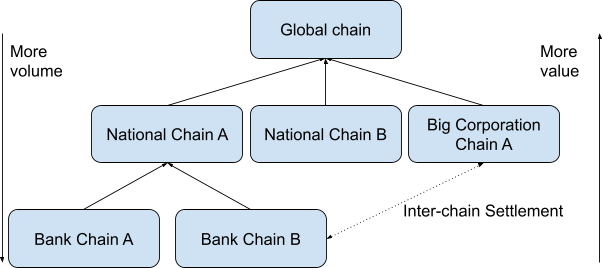
As such, it might be feasible to construct a tiered blockchain that would be able to offload a good amount of transaction volume off the main chain while still allowing settlement between tiers. At the top of the chain we would perhaps have a public blockchain where the highest-tier peers would issue their IOUs - governments, biggest banks, etc. Below that, we would have sidechains maintained by various banks and other financial institutions. This would allow them to perform more internal transaction without cluttering up the main chain. If needed, more sub-sidechains could also be introduced to further increase transaction throughput. One could also perform sidechain-to-sidechain transactions through a dedicated protocol (such as what Interledger is proposing).

It would be useful for the top of the chain to be a public blockchain as it would allow more institutions and possibly even governments to join and integrate directly with it.

Sample network graph of a tiered blockchain:


Proof of Solvency


One very interesting concept that emerged from the Bitcoin world is so called “proof of solvency”. It allows institutions such as exchanges or gateways create a positive proof that they own a certain amount of currency and that their liabilities are no greater than their currency reserves. Depending on the system in question, the proofs can be either be complete (proving beyond a shadow of a doubt both the assets and the liabilities) or disprovable (one can present undeniable evidence that the institution is lying).

The first scenario is mainly applicable for completely open ledgers - in most cases, only cryptocurrencies and Crypto 2.0s. For example, BTC2Ripple can prove both that they own a certain amount of bitcoins AND the level of their outstanding liabilities on the Ripple network. Since both networks are open, the transaction can be verified to be true or false at any given time.

The second scenario applies whenever we’re dealing with either closed networks, or networks that don’t provide cryptographically signed proofs. This includes exchange’s private databases and bank statements (barring something like TLSNotary). In this case, we either have to rely on some signed documents or PDFs supplied by the banks about the account balances, or generate a merkle tree of all account balances on an exchange. An exchange cannot prove that the information is complete, but anyone can prove the data is invalid if they find their account balance either omitted or altered.

As such, Proof of Solvency can be an important tool for financial audits, allowing them to be performed at any time without disrupting the normal business operations. Some institutions might even opt for continuous proof - updating the required information in real time to bolster confidence in their business.

Proof of Solvency might be fairly straightforward in the above proposed tiered blockchain. Any balance in a sidechain should equal to the amount of assets held at the higher-level chain. The top-level chain would have clear balances of who has how many assets and liabilities.

Voting Pools and auditing competitors


Voting Pools are an interesting idea for keeping everyone honest. In this approach, we have multiple parties vouching for one another’s solvability and being liable for bailouts in case one of the parties goes under. For example, we could have multiple exchanges forming a voting pool and keeping their bitcoins in multisig addresses such that even if one of them turned rogue, they couldn’t defraud their customers nor turn insolvent. This is made possible with continuous proof of solvency, as explained above.

Voting Pools could also be useful for having multiple institutions creating IOUs backed by all of them. These could include:

  • The Euro currency, issued by the joint agreement between multiple EU countries 
  • International Special Drawing Rights issued by the International Monetary Fund 
  • Fiat IOUs backed by multiple banks 

While Voting Pools are the most efficient in a network based on native cryptocurrencies such as Bitcoin, the concept might also be used in permissioned blockchains.

Smart contracts


The final catch-all solution for everything one couldn’t predict while designing the system. Smart contracts are flexible programs that live on the blockchain and can execute commands based on the state of the network. Coupled with smart oracles, the contracts allow for creation of such projects like a decentralized prediction market.

Conclusions


There are many practical applications of the blockchain technology for banks and other financial institutions. Failing to embrace the new technology might make the old network obsolete. The above are only some of the examples of what can be achieved and it is very likely we will see a lot more innovation in the following years. Even from those building blocks we can construct innovative technologies (such as self-regulating universal basic income).

Senin, 05 Oktober 2015

Blockchain for banks - an overview

As discussed before, the banking world appears to be looking into the blockchain space with companies like Digital Asset Holdings or R3 CEV gaining some momentum. However, a lot of people seem to see the blockchain as a silver bullet to solve a number of unspecified problems for the banking industry. Today, I would like to share with you a possible overview of how a blockchain-powered banking system might work using both public and permissioned blockchains.

Identifying the problem


There are many different needs that both the banks and their customers have. A commercial bank will have different priorities from a retail bank, and they both will have different priorities from an investment bank. The blockchain technology is very well suited for settlement between parties. More complicated functionality can be either accomplished by a more focused technology like Open Transactions or more general smart contracts available for example on Ethereum. We will mainly focus on the settlement problem in this post, but will mention other issues as they fit in.

Is blockchain the way to go?


A blockchain is a very specialized tool. As discussed before, it is similar to a database, with a few notable differences. Performance-wise, blockchains might not be as efficient as centralized or distributed databases, but what they lack in performance they make up in other areas for some projects.

A blockchain enables accountability. A public blockchain like Bitcoin is a publicly verifiable, unalterable record of history. A permissioned blockchain may still be subject to forging of records if it is kept completely private, but if it is shared with an independent auditor or a digest of the records are anchored in projects like Factom, they can also be provably unalterable.

A blockchain is also a good way of reaching distributed consensus if the involved parties don't trust one another, say for international bank settlement between Russia and USA. If all parties run on the same protocol with conflict resolution, there is no doubt which transactions came through and in what order for example.

On the flip side, depending on the technology used, the blockchain might have lower transaction throughput than a dedicated, centralized server / database. At the moment the fastest ledgers update in 2-5 second intervals (in case of Ripple). To go faster, one would need to use ledgerless technology, such as Open Transactions.

Public versus permissioned blockchains


When we have identified which problem to solve and believe using the blockchain is the way to go, we should consider whether to use public or permissioned blockchains to help us achieve our goal. Pretty much everything that can be done on a public blockchain can be also achieved on a permissioned blockchain. Bitcoin and coloured coins act similarly to MultiChain. Ethereum can be approximated by Eris, and Ripple - by Hyperledger. Worst case scenario, most crypto projects can be forked from their open source repositories and modified to suit the particular needs.

Since the permissioned blockchain is handled by known, controlled servers, it can be pushed to achieve higher performance than a public blockchain by using higher-end hardware and network capabilities. Similarly, the more controlled environment is not at a whim of spammers, transaction fee fluctuation or any external forces.

That being said, a permissioned blockchain in many cases is a walled garden barring entry to a lot of possible innovators. While this can be useful for protecting sensitive information, you can also miss out on the network effect from using the public blockchain. It's just like the internet and the intra-net - both have their uses and drawbacks.

For a lot of applications, it might make sense to either be completely on a public blockchain, or at the very least operate on both the public and permissioned blockchains at the same time. For example, if SEPA operated its own permissioned blockchain to offer settlement between all the European banks, it could also offer similar services on a public blockchain for lower-frequency transactions and perhaps a bridge to connect between the blockchains. This way if someone decided to build, say, a settlement corridor between Europe and America, they could use the already available public blockchain without having to apply for a banking license to get access to the premissioned one. This would enable more innovation to take place on low-performance environment while keeping the core network performing very efficiently for high-volume transactions.

Just to note - a public blockchain does not mean everyone would be able to use the solution indiscriminately. Pretty much every blockchain offers some way of controlling who can access various currencies issued on it, either through the use of white- and blacklists or through multisignature. This means that the banks or governments can still follow with KYC and AML requirements, even if the blockchain is public for viewing.

Picking the right approach


As with most situations, there are many ways to approach a problem on a blockchain. For example, in order to do international settlement, one can issue fiat-denominated currencies, copy an existing FX market and use that for currency conversion, use an intermediary cryptocurrency like Bitcoin (an approach used by Abra for example), or perhaps create a smart contract to handle the trades. The number and kind of options will depend on your problem at hand and it's hard to generalize this point.

Rabu, 25 Maret 2015

An open letter to Senator Ringuette

Dear Senator,

Recently I revisited some recordings of the Senate hearings on Digital Currency from 2014-10-02. I appreciate the number of very insightful questions you have raised to the panel - it was a pleasure hearing both them and the answers to them.

During the hearing you brought up the fact that Canada Post holds a bank charter in Canada, and that the company is in need of extra revenue stream. I would like to address some of the possibilities that this fact brings to both the world of Bitcoin-related companies in Canada, as well as the wider Canadian population as a whole.

In the modern world, there are a number of technologies and services that have emerged in the recent years that are essential in everyday lives. Many people would count access to the Internet as well as banking to be among them. I will leave the discussion of the former and focus on the latter.

Efficient banking as well as access to digital payment methods is needed for virtually every business and is prevalent in personal lives of many people. However, as was illustrated multiple times in the hearing by Michael Perklin, all of the banks are private companies and have the right to refuse business to anyone they choose without any legal reason. This problem is not unique to the Bitcoin world - there are a lot of banks that discriminate against people with poor credit scores or dealing in "taboo" businesses. Such people essentially become "unbankable" - unable to take part in the modern economy that is largely driven by online purchases and digital payments.

If the Canadian Government decided to address this issue by offering even the most basic banking services through Canada Post indiscriminately to anyone in Canada, it would not only help the Bitcoin businesses, but also many of the disenfranchised people living in our Country.

I know Canada is quite open to innovation. The former MintChip project by Canadian Mint, or the possibly future project of Bank of Canada are a clear indicator that the Canadian Government is interested in the digital currency space. I do believe that no matter which direction projects like these go, Canada Post will be playing an integral role.

The current "Big Five" banks hold about 920 to 3'330 branches each in Canada, while Canada Post has over 6'000 post offices. Similarly, a lot of those offices are open for twelve or more hours per day, while a number of bank branches are open for less than eight hours per day. As such, Canada Post is an ideal solution for money deposits and withdrawals, as well as everything else that is needed (performing identity verification for example) - the post offices should be accessible to every citizen.

There are of course many other services Canada Post could offer to help with payments, such as delivering money directly to the recipient's nearest post office (as is the case with Money Orders), or perhaps even directly to their home address.

However, from what I learned talking with a few Bitcoin businesses that require efficient, traditional banking for the core of their business, all that matters to them is to be able to receive money from their customers, be able to pay their suppliers efficiently, have confidence that their bank account won't get shut down, and have all of this at an affordable rate.

Even this little is too much for a lot of banks. I have done some research on international banking for Bitcoin businesses and I have seen Canadian companies banking in Czech Republic, or companies from USA banking in Malta not because these banks are the best, but because they can't open a local bank account.

As such, I am grateful to you Senator for bringing this issue up and I remain hopeful that the future will give us a more inclusive banking system, whether it is in Canadian Dollars, or Bitcoin. I am open to any follow-up discussion, questions or general consulting you or anyone else from the Canadian Government might have.

Sincerely yours,
Piotr Piasecki.

Rabu, 31 Desember 2014

Ripple as middleware

As many people may know, the current banking system is a mess when you're dealing in multiple currencies. We have disjointed networks dealing in local countries, the eurozone, and international banking on a wider scale. Using Bitcoin means having to hop onto the currency and off of it on two exchanges. There is friction at every step and companies have to focus on creating big end-to-end solutions rather than focusing on just the part they can do really well. However, I believe all of this can be simplified if we used a system like Ripple as a middleware layer.

The current situation


Currently, there are many disjointed markets out there. If you want to exchange fiat currencies, you go to a forex. If you want to buy Bitcoin, you go to one of the numerous local exchanges. For altcoins, you will most likely need to go to one of the handful websites that specializes in them. All in all, there are many problems in efficiently dealing with say, exchanging precious metals for altcoins.

Ripple as a solution


While Ripple might not be able to completely replace centralized markets that have high transaction volume and extremely low latency, it could be a good enough approximation for a lot of the projects out there.

First step in doing this would involve the creation of various gateways for the currencies we wish to use, be it USD, gold or whatever else. Since the gateways can focus only on one thing at a time, creating them is more straightforward than bringing newer and newer exchanges onto the market. If you can only handle Bitcoin but can't make a trade engine or handle fiat, you're still in business.

The second step would be copying the existing markets into Ripple through automated arbitrage bots. For example, you could take Bitstamp's USD-BTC market and post trade offers in Ripple to mimic it, although with lower granularity. When a trade is made on the network, the bot would offset it at the exchange and create profit. Given enough bots, we can represent any number of financial exchanges inside of Ripple, no matter what currency they're dealing with.

The third step would be building services that use Ripple as middleware for their payment network. Say we want to tackle Europe<->Canada money transfers. We would connect to a gateway in Europe and a gateway in Canada. When we see a Euro payment on one end, we send it to the first gateway, use the Ripple network to trade it for Canadian Dollars, and send the money out on the other end as needed. Provided we have some floating balance on both ends, we just completed an international wire transfer in 5 seconds at a fraction of the cost.

The last step would be...

Optimization through competition


Obviously, the markets will only use a product if it’s competitive and affordable. Nobody will want to pay a premium to use one product over a cheaper one with the same features. However, the beauty of this approach is that all components are interchangeable and the best ones will win.

Looking at our BitPay example, their business can be broken down into the following components:


  • The frontend gets the current exchange rate and accepts payment for the goods from the user, eventually forwarding the coins to the exchange
  • A server offsets the trade at an exchange
  • A banking component withdraws fiat from the exchange and pays the merchant in their currency of choice


In Ripple those components could be run by different entities:


  • A system like BitPay would accept customers’ coins and use Ripple to pay the merchant. They could trade the coins directly for any fiat or any other currency on Ripple, and once the funds are secured, release the payment.
  • Trades would happen atomically in Ripple. No matter how many currency hops it requires, a trade could be made with one transaction. The Ripple network will find the most efficient route on its own.
  • Any trades happening in the Ripple system would be offset by independent bots arbitraging between Ripple and various exchanges (forex, Bitcoin exchanges, etc.)
  • Merchant payouts could be handled by dedicated gateways or payment processors working with the gateways. Say, any funds deposited to a given Ripple address could be paid to a specified bank account at the end of the day.


Since the system does not require one company to handle all of those steps, multiple entities can be competing against one another to build the most efficient pieces of the puzzle, and the system as a whole would benefit. If one arbitrage bot is replaced by another that has a tighter spread - the prices go down. If someone makes a direct market between two distant currencies - the network will route through the new path, saving money. If a new payment processor comes along, they don’t need to reinvent the wheel, they use the established network and focus on making a better product. All of the components are interchangeable, and the most efficient ones will win in the end.

Possible applications


Here is a list of applications that can easily use Ripple as a middleware money network, given enough development in the space:


  • Payment processing between any currencies (BitPay, Coinbase, PayPal)
  • Exchanges (using Ripple as an exchange engine)
  • Remittance and other international payment networks (Western Union, PayPal)


Near future developments


If our guess is correct, we expect to see the following projects to start appearing in the Ripple space in the near future:


  • More fiat gateways. They should appear in places financially close to big exchanges making payments between them easier. Alternatively, big exchanges will become gateways as well (like BitStamp)
  • Given efficient gateways, arbitrage bots will appear converting every Bitcoin exchanges’ market into Ripple. We’ll see BTC-e’s LTC/USD market reflected in Ripple, BTC China’s BTC/CNY market, and many more
  • Arbitrage bots will start appearing next to large forex markets, bringing in efficient fiat<->fiat exchange rates into Ripple
  • Given some of those, payment processors like BitPay will start appearing in the Ripple space offering payments to any currency accepted by the merchant
  • Either gateways will start offering new and convenient ways to convert people's traditional money into Ripple IOUs (say, through credit cards or other automated systems), or we might see companies like Coinbase appearing to offer this sort of services for them


Conclusions

As I wrote in a previous blog post, cryptos will succeed if the banks are failing. Due to the many inefficiencies of the current international payment systems, it is very likely that a system like Ripple would be used more and more as a common middleware to enable interoperability between many networks.

Recommended reading: